About your Tai Chi Form
There are two ways to do the form :
the easiest way and the correct way.
Erle Montaigue
Grand master Erle Montaigue's
Yang Lu Chan's form:
Basic stuff.
It was impossible to not learn from him.
The origin of Tai Chi Chuan was a fighting art and different from the new age style taught in many places. Erle Montaigue : "The Western mind was just not ready for the effort that needs to be put into learning such an art. So we changed it to a simpler form, that of an excercise". On the other hand if one focuses on a particular use for the form, you are closing yourself off to the thousands of possibilities. You must'n be too ready for a particular thing, so that you are more ready for anything. Tai Chi isn't about learning correct postures, deadly fighting techniques or some hocus-pocus, it's about deeper ability, grounding, internal strenght, connection and connectivity. About song. It's about life as it is, not about styles, Shaolin attractions, or Youtube stuff.
There are two ways to do the form, the easiest way and the correct way.
Later you'll find out that the correct way is the easiest way.
"Life is a series of natural and spontaneous changes.
Don't resist them, that only creates sorrow.
Let reality be reality.
Let things flow naturally forward in whatever way they like".
Lao Tse
Real Tai Chi means
letting the natural order of life flow through one's being.
When we understand the flow of life we don't force or fight it.
What means:
Don't follow the flow, be the flow. Don't follow the Way, be the Way. Don't practice
the form, be the form. If you act spontaneously in harmony with nature (Tzu-jan), then
you are the flow, the Way and the form.
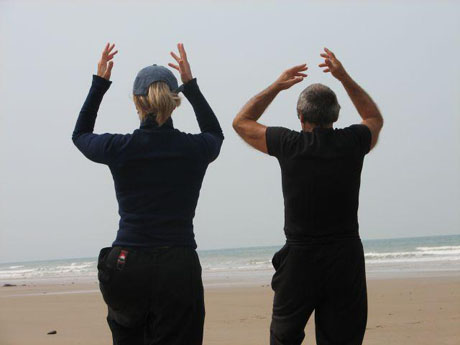
A Tai Chi form is a sequence of natural movements;
full/empty, slow/fast, open/close, soft/hard, large/small
that adhere to the basic Taoistic principles of Yin and Yang.
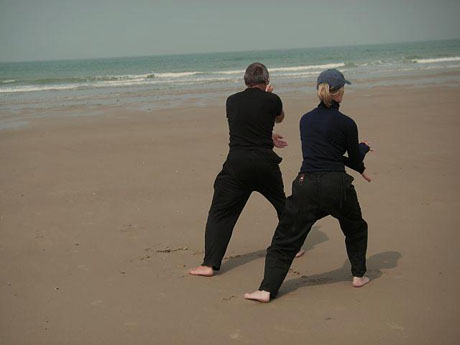
Yang Lu C'han's form
Advanced forms contain twisting and spiralling,
silk reeling and also 'chin/song' movements.
Advanced forms :
Yang Lu Chan's form or "The Old Yang".
Even in short Tai Chi forms martial applications are there, and yes I like the martial
benefits of Tai Chi Chuan but there are more Tai Chi benefits than fighting. 'Regular
Yang Tai Chi forms' (Yang Cheng Fu's form) should be practiced without fa-jing, and that's
not the same as saying that the Yang family didn't teach fa-jing. It simply means that
in earlier days fa-jing was not taught to outsiders of the Yang family and it's not only
the Yang style that doesn't show fa-jing movements in the form. That's okay folks, Yang
Zhen Duo or Fu Zhong Wen don't show fa-jing in their Yang form, but as far as I think
Nature itself shows it's own fa-jing movements. It is said that Tai Chi Chuan is taught
as an healing-fighting art. Well then, fa-jing training is essential and therefore all
advanced Tai Chi levels have fa-jing training. Fa-jing is the expression of natural power,
generated from the legs, anchored by the feet, controlled by the waist, channelled through
the spine and expressed through the limbs. When expressing fa-jing in Yang Lu Chan's form
the power can be focused to a point, but even in Yang Cheng Fu's form a practitioner should
be able to perform any posture explosive with full power or slow, so that the natural power
can be observed or maintained from the beginning to end.
All Tai Chi forms are as good as the player and who cares when a form was created and by who.
Many Tai Chi people claim theirs to be original, but to me you must pursue to the end that
which you know in your heart to be true, strong Tai Chi principles that one can apply to
their everyday life. What's the problem with Yang Lu Chan's form or the Old Yang? As Erle
Montaigue said the Old Yang has received much controversy since he introduced it back in the
80's. Some people say that Erle simply invented such a perfect form of self-defense and healing.
And that's all OK, it does not matter who invented this form, Yang Lu Chan, Erle Montaigue or
his teacher Yiu-Chun. Erle Montaigue : "The fact remains that whoever learns this form or even
sees it performed looks on in awe at such a beautifully powerfully and still set of movements,
rolling by in complete harmony with nature and the internal flow of Qi, with the occasional
fa-jing movements representing the "Great River" and its most by flowing softly but often
violent actions".
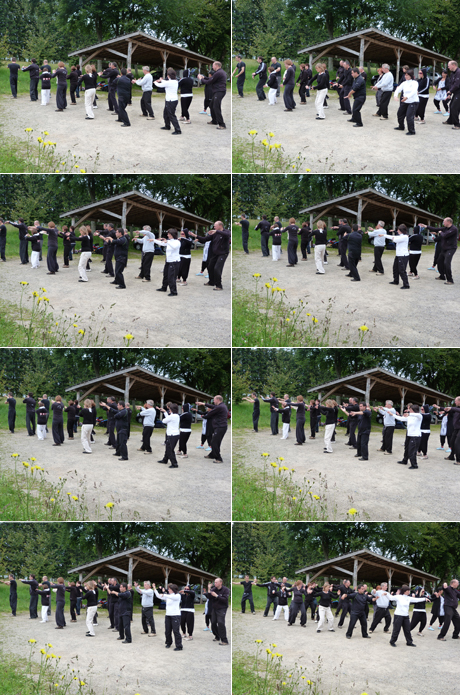
The first part of Yang Lu C'han's form differs only in details
with Yang Cheng Fu's form.
I have great respect for the traditional Chinese values such as respect for the family,
parents and ancestors. I have great respect for the Chinese culture, for the art of Tai Chi
Chuan, for the genius who invented the Old Yang. To me the Old Yang represents the river of life,
flowing softly but often violent. We are the flow and the river.
As far as I think the problem with Yang Lu Chan's form is what some Chinese call "a well-known
Australian instructor". "His form is not the traditional Long Form of Yang Tai Chi, not original
at all, his form is the original form from the other planet, I'm sure... and etc." Criticism is
necessary, but it is easier to be critical than to be correct. Don't resist critics, that
only creates sorrow, when we understand the flow of life we don't force or fight it.
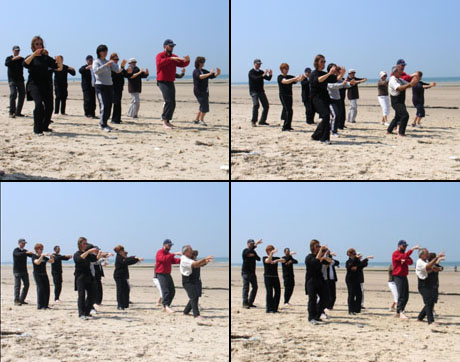
Yang Cheng Fu's form.
"Flow with whatever may happen and let your mind free".
Lao Tse.
The river of life flows, it is the source of all nourishment.
Follow the flow.
The way animals move.
The way animals move is both efficient and pure in the sense that they are close to the natural source. Most animals are
looking supremely relaxed. Think for instance of birds, monkeys, tigers. The observing of the animal kingdom influenced the shape, content and
patterns of Tai Chi Chuan, some animals play an important role to represent meanings, powers or forces. Animals are rooted
in the earth, like trees are rooted in the earth, and humans are dependent upon earth every bit as much as animals are dependent on
the earth. All Tai Chi movements are very close to the essence of life. Sinking and rooting are one of the most important
aspects of Tai Chi Chuan, the rooting and sinking practice relies on being relaxed and on going slowly in order to feel
this sinking and rooting.
The animal energy is man's 'bloom of vitality'. Most animals are looking pleased with themselves, their movements evoke
harmony and natural beauty, and they seem to act on the psyche and serve as powerful symbols. Each animal has his own
spirit and his own soul (man and animals have bodies, and are souls=life), a living creature life is equal to the soul of
that life. Daoism posits no basic dichotomy between the physical body and the spirit or the soul, which might inhere therein.
In other words, an expression like "body and soul" would make no sense to Daoists, for all things are Qi. In Yang Cheng
Fu's form, in my mind there is an eagle. Yang Cheng Fu's form opens the body.
See this: Link to YouTube
I associate Yang Lu Chan's form with tiger qi, sometimes with monkey qi, and sometimes with bear qi.
However, the internal version of Yang Lu Chan's form must be a Water Dragon form, I think.
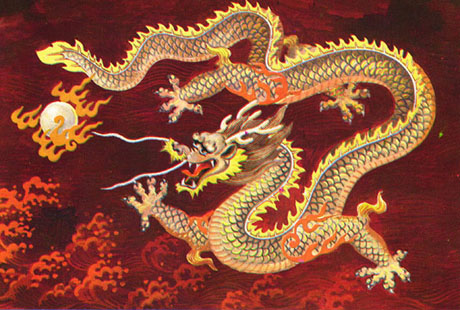
The way the dragon moves.
In heaven as in earth, Chinese culture has rich stories and myths that reflect Chinese people's ways of thinking, things
they value and respect. Taoism has always been an environmentally sensitive philosophy, it describes everything in relation
to the Ultimate reality (Tao), and the different aspects of the invisible world of Tao are all found in the various forms
of the visible physical world. In the twilight zone between the visible and the invisible - the zone between being and
non-being - the dragon represents all benevolent forces in Nature. The Earth dragon (element Earth) is related to the
spleen and creates harmony in the universe and in all organs. The spleen plays a central part in health and vitality of our
body, it governs transformation and transportation and for this reason fatique and blood deficiency are often attributed to
a beakdown in the spleen's ability to transform qi and blood. The spleen likes warmth and dislikes cold, it dominates the
muscles and the limbs. Since the spleen is resonsible for transforming qi into blood, a person with deficient qi often
experiences weakness and fatique.
The Chinese dragon.
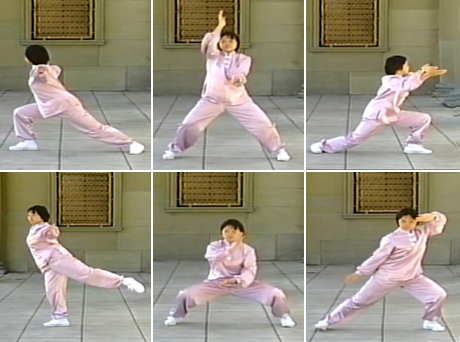
PLEASE SEE THIS: Link to YouTube
Taichi Qigong - Taiji Swimming Dragon Quan
I wish I could do that!
In my opinion this 'Swimming Dragon fist form' must be one of the most beautiful Tai Chi forms. There is an amazing
yin-yang balance in every movement, watching it gives peace.
The dragon is the heart of the Chinese culture, let me explain: Chinese show great respect towards the dragon. In western
mythology the dragon was often the symbol of evil, but the dragon (lung or long) is a prominent feature in the legends of
China. For some special reasons dragons occupy prominent positions in the Chinese mythology. Chinese dragons are almost
benevolent creatures, they are the symbol of power, luck, courage, dignity, righteousness and wisdom, and... they can swim,
they can fly in the sky, etc. There are all kinds of dragons : celestial, spiritual, hidden, underground, yellow, red, blue
dragons, water, wood, and metal dragons, fire, earth dragons... The Chinese dragon is made up of many animals, the neck of
a snake, the claws of an eagle, and his scales are that of a carp. The head of a camel, the eyes of a demon... Why?
Chinese believe a dragon is a free spirit and do not like to play the rules, dragons would set their own rules. Dragons
have a hard time playing the rules because they simply don't believe they are created for them. The Chinese dragon is able
to swell up to fill the entire space between heaven and earth and then to shrink to the size of a silk worm.
2012:
The year of the great Blue Water Dragon Wuwei seminar!
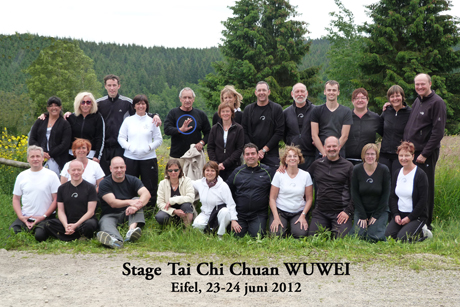
Kalterherberg im Eifel: (see the Tai Ji Blue Water Dragon claw).
The Blue Water Dragon opens communication to the spiritual world. Water Dragons are capable of maintaining a perfect Yin-Yang
balance of creativity and intelligence with spirituality. Let the dragon lend you his wings to progress beyond what you think
is possible for yourself.
The Water Dragon is about balance : fire and water, about health because health is the ultimate balance between fire (Yang) and
water (Yin). We can see illness as a state of being out of balance, with health as a balanced state. Health is as flowing water,
water produces wood which signifies healthy growth and which is a dynamic and vital health, but... the reality is that growth
brings complexity. So the Blue Water Dragon represents dynamic, vital and balanced growth, keep in mind that in TCM (Chinese
Traditional Medicine) health is a dynamic and a balanced vital process.
The Water Dragon represents so much more than health, balanced growth, spirituality, intelligence, flowing water and some good
blessings, he also represents the dynamic and balanced full of life woman and man. Life itself holds so many simple blessings,
just to live is a blessing. Life teaches that although the world is full of suffering, it is also full of the overcoming of it.
May life bless you abundantly, all events are blessings given to us to learn from.
Bless a thing and it will bless you, what is happening has the power to bless you and don't be hypnotized by appearances, the
Chinese dragons can appear and disappear instantly, and can quickly change their form and size. Life itself is a balanced state
of being, when we lose one blessing, another is often unexpectedly given in it's place. So the Water Dragon is about balance,
in a balanced state we can appreciate and enjoy the experience of being alive right now.
Phylum molusca.
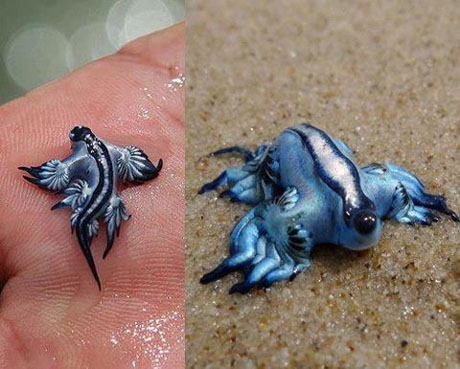
Little blue dragon : Glaucus atlanticus.
Water Dragons.
Water dragons are believed to mostly inhabit the lakes. The water dragon represents good negotiations, water dragons will
act wisely and intelligently make well researched and smart decisions. Some of his scales are yang, the other are said yin
to keep the water dragon in perfect Yin-Yang balance, Dragon people are brave and self-assured, water calms the dragon's
fire (2012 was the year of the water dragon). Chinese believe in balance and transformation. For example : the transformation
from fish to Dragon (the Arowara is a dragon-fish). According to legend, the carp is noted for its strenght and bravery
because it swims against the current. They must swim against torrents and clear a huge task, and, according to some the
carp turns into a Dragon when it makes a final leap over the rapids. In Chinese mythology there is a 'dragon gate' where a
fish (carp) can become a real dragon, if they complete this they can become a dragon themselves. The carp fish jumping over
the Dragon-gate has the meanings of achieve high rank.
In Chinese mythology, it is believed that all things and animals are capable of acquiring magic power or human faces.
All dragons are known for their creativity, the yellow dragon was the symbol for the emperor himself (the yellow emperor
with 'the dragon face'). The blue dragon, the water dragon (associated with element water) is the king of dragons. In
heaven as in earth, blue sky over blue lake, water dragons don't stay small for long, they may devote themselves to a great
cause of work, and if so, they will see it through to the end. This talent works in two ways, the dragon is capable of
soaring to the highest heavenly highs or diving to the depts of the sea... However, water dragons will be a succes wherever
they go, regardless of their choosen careers.
So, hope it was helpful and you check out some Tai Chi dragon videos. Train Tai Chi up in the Mountains or meditate near
'the Dragon pools', hoping one day you'll be a blue, yellow or a red dragon (Chinese saying), hoping one day you'll be a
water Dragon. Life is like a river flowing, if you don't swim against the current, it will take your hope against your hope.
There are many different styles of Tai Chi
but most adhere to the same 13 basic principles.
The Yang Style is the most practiced style.
The Yang Cheng Fu form develops softness and strenght at the same time.
The Yang Lu Chan form or the 'Old Yang'
is the oldest version of the Yang Style.
Short Tai Chi forms are strange things.
Tai Chi is not short.
You must have long range goals to keep you from
being frustrated by short range failure.
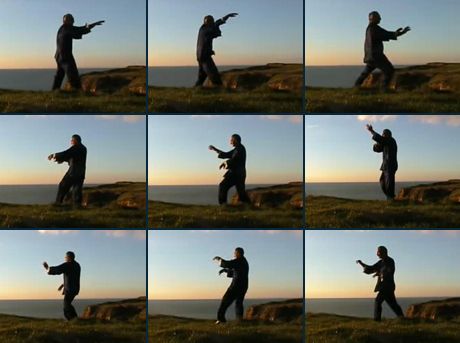
The13 basic principles of the most Tai Chi Styles are the same:
1. Sinking the shoulders and dropping of elbows.
2. Relaxing of chest and rounding the back.
3. Sinking chi down to dan tien.
4. Lightly pointing up the head.
5. Relaxation of waist and hip.
6. Differentiate between ying and yang, between empty and full.
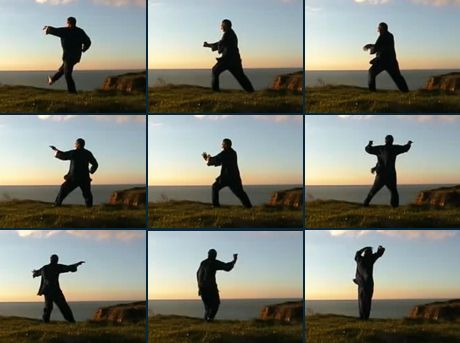
7. Coordination of upper and lower parts of the body.
8. Using the mind instead of force.
9. Harmony between internal and external.
10. Connecting the mind and the chi.
11. Find stillness within movement.
12. Movement and stillness present at once.
13. Continuity and evenness throughout the form.
Words, words, words...
The problem with words is that there are so many of them.
The ear is the organ that deflects sounds.
The eye is the organ that deflects light, colours and movement.
To learn Tai Chi Chuan use your eyes.
Once up in a time in a Japanese Garden.
Clarity is the first step to mastery,
it takes years to learn how to take meditation into martial applications.
Stay sung, think fast and wait.
Be patient, your form will answer all your questions.
Everything is always changing.
The goal of Tai Chi Chuan should not be to impose
universalized standards of posture.
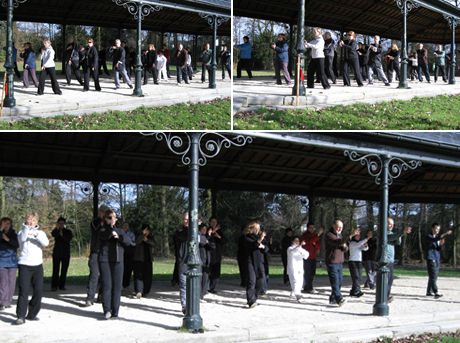
The goal should be to help the individual to cultivate
mental awareness and physical flexibility to adapt
to the changing needs of the moment.
Everything is always changing: don’t resist changes.
Focus on relationship and not facts.
Do not sandwich double weight.
Double weight is fifty percent weight of both feet, hands and dantien.
Both feet cannot be moved, both feet cannot be changed.
When your practice is refined, even the smallest place is circular.
So, where can there be double weight?
See the differences.
There are relative degrees of both upwards and downwards.
There are relative degrees of both Yin and Yang.
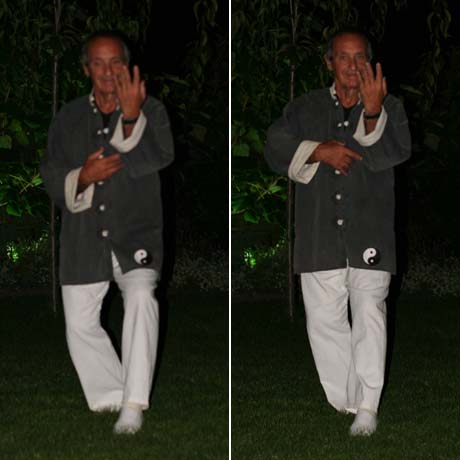
The same movement, different Ying and yang changes in the hands and feet.
Wich makes one relative yang and the other relative yin.
Yin and Yang are relative to each other.
There is always Yin within Yang, and Yang within Yin.
There is always Yang within Yin, and Yin within Yang. The question about day (yang) and night (yin) teaches something
about our observation, day (yang) and night (yin) are relative to each other. It also teaches the relativity of time.
It teaches that our observation is limited by the frame of the observer and by whatever the observer chooses to see.
We make observation errors all the time, every observation is both true and false. It teaches that every person who
disagrees with us is right just as we are. No matter how right we think we are. And vice versa. The deeper understanding of
Yin and Yang helps to deal with negatives we encounter by understanding where they come from.
Master Erle Montaigue: "You start to learn the form, later on the form starts to teach you".
Master Montaigue has right, your form teaches the relativity of Yin and Yang, finally your form teaches the
relativity of all things. That's the reason why - in advanced Tai Chi Chuan - the yin-yang changes in the
hands (fingers) and feet are important.
Move with the dantien as center.
Revolve your dantien forward and backward.
When rising turn the dantien upward,
when falling turn the dantien downward.
Look forward and listen backward to ensure psychical balance.
Don’t look back in anger.
Don’t look forward in fear but around in awareness.
Nothing is to be feared, it is only to be understood.
Correct breathing is a health booster.
Tai Chi teaches abdominal diaphragmatic breathing
as the basic principle for practice.
After years every move you make, every step you take follows
the principles of Tai Chi.
Your generator is always working.
 About the form.
You start to learn the form.
Later on the form starts to teach you.
Erle Montaigue
Chang San-feng's Treatise on Tai Chi
from
Tai Chi Chuan According to the I Ching
With every movement string all the parts together,
keeping the entire body light and nimble.
Calmly stimulate the chi, with the Spirit of Vitality concentrated
internally.
Avoid deficiency and excess; avoid projections and hollows;
avoid severance and splice.
The energy is rooted in the feet, transmitted through the legs,
directed by the waist, and expressed in the hands and fingers.
The feet, legs, and waist must act as one unit,
so that whether Advancing or Withdrawing, you will be able to obtain a
superior position and create a good opportunity.
Failure to obtain a superior position and create a good opportunity results
from the body being in a state of disorder and confusion. To correct this
disorder, adjust the waist and legs.
Likewise, upward and downward, forward and backward,
leftward and rightward--these are to be directed by the
Mind-Intent and are not to be expressed externally.
If there is above, there must be below. If there is Advancing, there must be
Withdrawing. If there is left, there must be right.
If the initial intent is upward, you must first have a downward intent.
If you want to lift something upward, you must first have
the intent of pushing downward.
Then the root will be severed,
and it will be immediately and certainly toppled.
Clearly discriminate the Substantial and Insubstantial.
There is an aspect of
Substantial and Insubstantial in every part
of the body.
Considered in their entirety, all things have this nature.