About Tao
Tao: "the Way all things go".
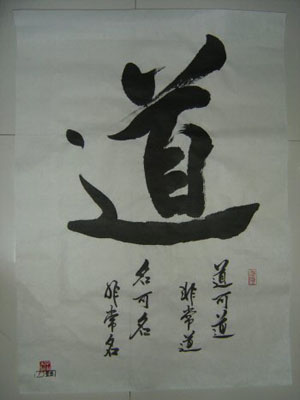
When the man of highest capacities hears Dao.
He does his best to put it into practice.
When the man of middling capacity hears Dao
He is of two minds about it.
When a man of lower capacity hears Dao
He laughs loudly at it.
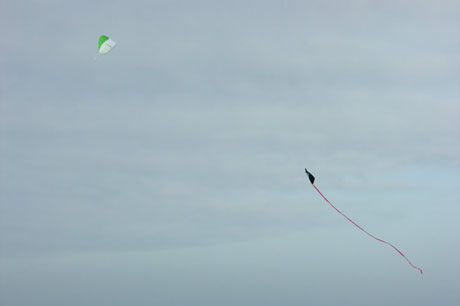
Photo : HugoLorent
If he did not laugh, it would not be worth the name Dao
Lao Tse
Those who talk do not know.
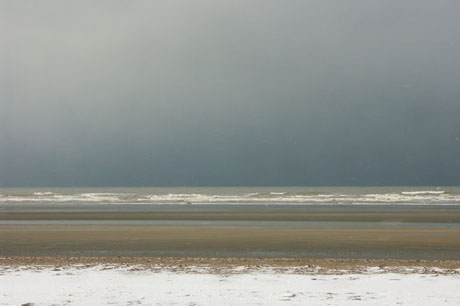
Photo : HugoLorent
Those who know do not talk.
Lao Tse
What does Dao mean?
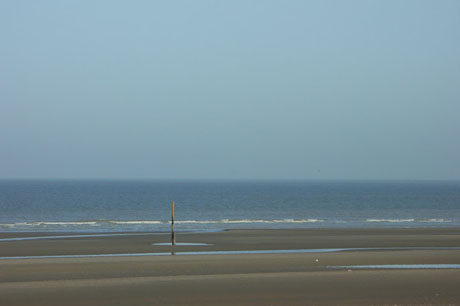
Photo : HugoLorent
What can not be put into words, makes itself manifest.
Lao Tse
Dao,
the Way all things go is empty
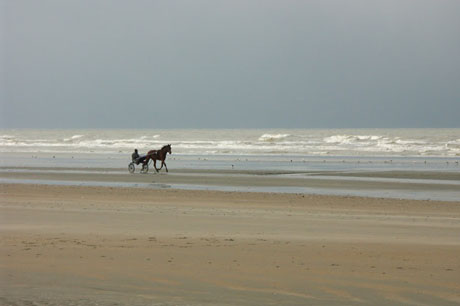
Photo : HugoLorent
and
nothing says that.
Nothing says that.
The way we walk seems clearly defined, but then, something happens. Your way looks unfamiliar.
You realize you have lost your way and: "those who talk about the Way don't know".
The road ahead is empty, It's paved, with miles of the unknown.
The road ahead never gives away a promise.
The road ahead never answers any questions and nothing is sure along the way,
not even tomorrow.
With miles of the unknown ahead of you.
*In Taoism the relation of the Dao (the empty Road-the Way) to all the world is like that of the
great rivers and seas to the streams from the valleys.
The Way is empty
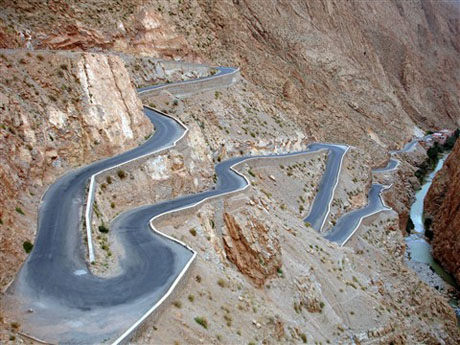
The Usefulness of the Way comes from what is not there.
The Way is paved with miles of the unknown, and nothing is sure along the Way.
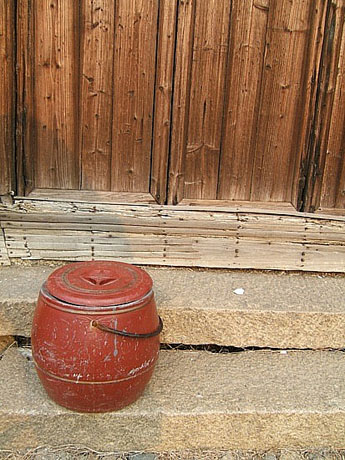
The Way is empty. Lao Tse: "Shape clay into a vessel.
It is the empty space within that makes it useful.
Cut doors and windows for a room. It is the empty holes which make it useful.
Therefore benefit comes from what is there. Usefulness from what is not there."
"Further: "To attain wisdom, (to walk the Way) remove something every day".
This ancient Chinese proverb illustrates the value that the Chinese culture places on nothingness.
"Nothing under heaven is more pliable than water. But when amassed, there is nothing that can withstand it."
We all make choices, but in the end we end up with nothing. Nothingness or emptiness represent the opposite
of fullness, and is one of the characteristics of the Way. There is no fullness without not-fullness (emptiness,
nothingness), what means that fullness and emptiness are one and the same. "Fullness and nothingness they
are not two things, only two concepts of the mind. Nothingness is better because it does not allow any
imagination to arise. But for the beginner it is dangerous because for him fullness means something against
nothingness."(Osho).
We know that early people were perfectly capable of understanding that everything comes
from something and that complexity arises from simplicity. Nothingness or emptiness is
the most perfect form of simplicity, so nothingness must be the most complete manifestation of oneness.
And now we come to the conclusion that "we are complete one in complete nothingness".
Therefore, in nearly all creation stories, it is the shapeless "nothingness" that is
the most original form of reality. Nothingness as the ground of being is pure potentiality,
to be whatever it is we wish to be, do, have, want. Perhaps, I think.
The Usefulness of the Way comes from what is not there.

Extraterrestrial Aliens on the way to Earth.
* What would really happen if we got this message from space? And the correct answer is that governments
should prepare for the worst if aliens visit Earth.
PROLOGUE
Dao is universal, it is not Chinese.
Dao Te Tsjing is probably the most influential Chinese book of all times. Not much is known
about Lao Tse, at least nothing that is certain, some even doubt whether he is the author of
the Dao Te Tsjing. His book only describes the nature of the universe, the laws that govern
it and the ideal ways that a person might place themselves in harmony with those laws.
Dao, the Universal Design, is an all inclusive design.
The Taoists sought to understand reality and how we are a part of it and exist under its natural laws.
What's the message of Lao Tse? Tao-Dao, the Way, the way all things go, is indefinable and beyond imagination.
Dao is "the Way not to follow", the less we talk, the more we're listened to. Lao Tse would
prefer the great silence. It's often just enough to be, to be with someone, to feel, to see,
to listen. People talk too much, better to concentrate on the message, rather then the (Chinese)
messenger or the (Chinese) words.
Dao, being the ultimate source of all reality, has no name; not even Tao or Dao. Not subject
or object. Not subjective or objective. Not truth or illusion. Not science or fiction. Not sin
or purity. Not one or many. Not I am or I am not. Not to be or not to be. Not yes or no. Not this or that.
Not you or me. Not here or there. Not now or then. Not life or death. Not duality or oneness.
Not nothingness, not fullness. Not not, not yes. Not something, not nothing.
Well, It seems to me that the great message of the Dao Te Tsjing is that language divides us,
maybe the universe has sent us this message. So It is not easy to actually describe what Dao is
without doing damage to its paradox. However, being the ultimate source of all reality, Dao
that is spoken (or written in this case), is not the true Dao". It is often said that the less
is said of Dao the better. This is very true, when I talk about Dao, what I am talking about
isn't really the Dao. We may wonder why Lao Tse should have said anything at all if "those who
know do not speak". And now we have a koan: "How then to speak meaningfully about that of which we cannot speak?
Lao Tse's words are difficult to understand for Chinese speakers as well, teachings like this
can be very hard to grasp when most people desire scientific evidences or concrete definitions
in their own life.
Language divides us, and this paradox needs context and obliges to offer a few universal guidelines.
Patricia de Martelaere: "Listening is a form of looking', 'stroking is looking with the hands',
'drawing is stop thinking', 'feelings do not exist', 'writing is a matter of looking', it has
to do with the whole world through my eyes. The less we talk, the more we're heard through the eyes".
Is it possible "to follow" Lao Tse's advices in today's society with all the new technology and time
devoted to work? And my answer is: More or Less. Sometimes more, sometimes less.
I think.
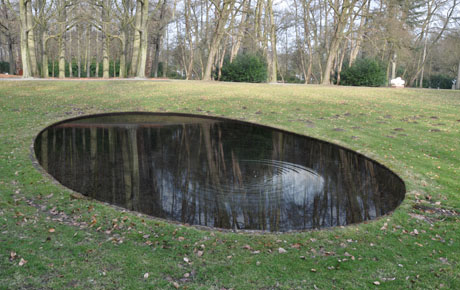
Photo : Philippe Van Snick
The Tao that can be told is not the eternal Tao.
Tao and Taoism are two different things :
Tao is the natural order of all things, it is "the Way" all things go.
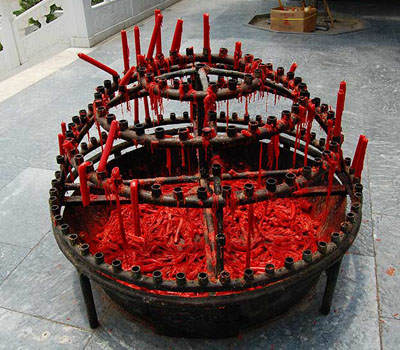
Taoism is the practice of the natural order of all things.
Humanity's task is to recognize and become aligned with "the Way all things go".
Taoism is the study and the practice of the Way all things go.
.jpg)
Taoism is hard to understand.
The study and the practice is to decrease day by day.
That's it.
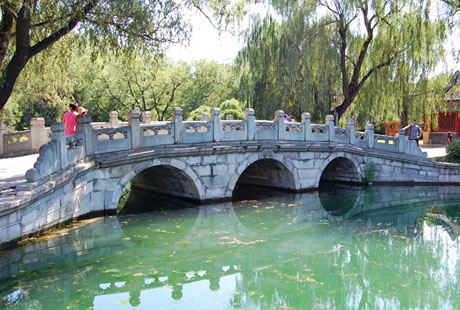
Buddhism, Confucianism,Taoism are the three pilars of Chinese civilisation.
The three pilars of Chinese civilisation.
Photo : Walter Swinnen
Confucianism was the first philosophy in China. The difference between a philosophy and a religion ? A philosophy only talks
about one should do in life, while a religion talks about the after life. Confucianism is all about the brotherhood of humanity,
and setting good examples. There are 5 key relationships : ruler-subject / wife-husband / older-younger / friend-friend / father-son.
Just this : there is a problem with examples and moral codes. The most powerful moral influence is example, but moral codes are ultimately
motivated by fear which makes us want to control others. The irony is that the more we try to control, the more disorder is created,
and that's precisely what Taoism implies. Terrorism itself is an example of the world's uncontrollability and unpredictability.
While Buddhism originated in the Indian subcontinent, Taoism emerged in China. Both are believed to have emerged around the same time,
in the fourth or fifth century B.C. Both Taoism and Buddhism are practice traditions rather than faith traditions; doing rather than
believing. Buddhists practice to attain personal enlightenment and to become free of suffering while the aim of Taoist practice is
more centered on personal harmony with circumstances and harmony with Heaven and Earth, we can say that Taoism is the religion of
Heaven and Earth. Both however are methods to attain to the mystical experience of oneness with the universe.
The most fundamental Taoist experience of oneness with the universe is to realize that humans are not exceptions to the natural process,
for they are manifestations of it. Humans are just "one of the 10000 things which Tao treats indifferently".
Humans are just one of the 10000 expressions of the Tao. Expression is never helped by control or suppression, so the "real man of Tao"
let all things come and go without desire, he never expects results, and that's why he's never disappointed" (Lao Tse). And that's precisely
what Taoism implies.
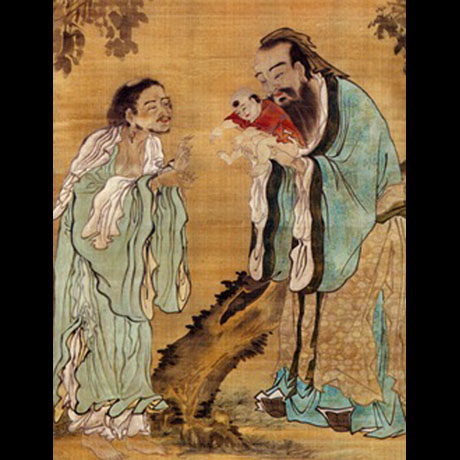
The three vinegar tasters : Buddha, Confucius and Lao Tse
they represent the three major philosophical traditions in China.
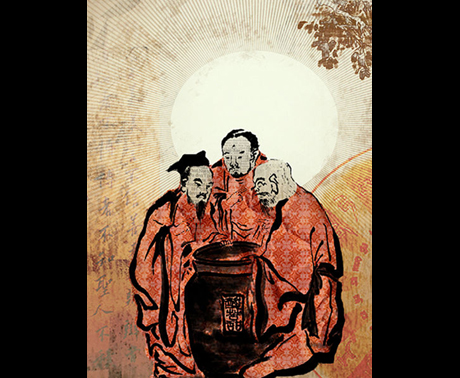
Buddha tastes the vinegar and has no expression, Confucius scowls,
Lao Tse smiles.
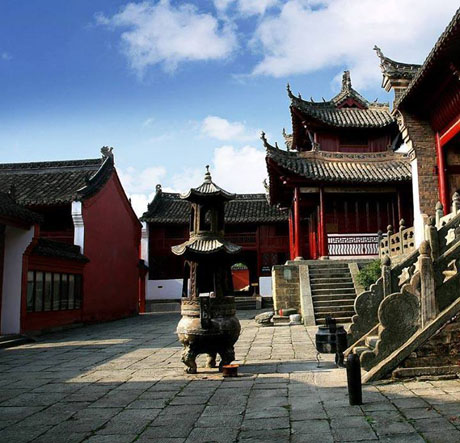
This is Needle-grinding Temple locates in Mount Wudang.
Legend has it that an Taoist taught people to do things persistently
for a final achievement.
HAPPY SERENITY
The three vinegar tasters are representative of 'the Three Teachings of China'. The three teachings are one,
the three jewels, love, moderation and humility are one, and the three chakra's, lower, middle and upper chakra are one.
Buddha saw life as bitter, Confucius saw life as sour, Lao Tse saw life as it is in its natural state. Life can be sweet
when utilized for what it is, nature is not a setter of bitter traps (Buddhism) and sour rules (Confusianism).
Life may be bitter or sour, how can we be anything but sweet and kind. Lao Tse's inner peace starts with a sweet smile,
he simply accepts vinegar for what it is : it's vinegar. He has no expectations. Most people go trough life expecting
certain things, but it is a most liberating experience when we are able to live life with an attitude of no expectations
and no regrets. The best things in life are unexpected because there were no expectations. In the beginners mind, there
are many possibilities, so many expectations. In Lao Tse's mind there are very few. The vinegar dilemma is a well known
bitter-sour/sweet yin-yang dilemma. Finally it's a koan. So what, the Supreme Ultimate Tao is undifferent to human affairs,
possibilities, expectations and desires. Expectations are simply another form of false hope, and no one should give up hope.
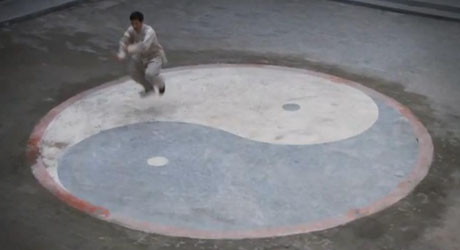
Following the Way of Tao leeds to happy serenity
Anger comes from frustrated ambitions and expectations. One of the most noticeable qualities of the Taoist personality is
'happy serenity and a subtle sense of humor'. It strongly makes the Taoist point that unpleasant experiences need not be
expunged, but can be enjoyed as an integral part of the natural flow of things. The Taoist accepts the unpleasant parts of
a stuation as well as the pleasant parts. Taoism offers the idea that the Tao is balanced state, everything has his own
place and function. What you resist, persists, when you are constantly classifying, expecting, labeling and evaluating you
create a lot of turbulence in your mind. Don't idealize the great art of Tai Chi Chuan, it's Tai Chi Chuan, it will never
live up to your expectations. Be happy with your form, your form is a form. Behind the world of forms, there is a timeless
level, there is the world of essence. Your form is only the birthplace of essence. It's the place where body and mind come
together, you cannot expect the form (body) before the idea (mind), for body and mind will come into being together.
Everything is always changing, go with the flow. The result of this harmonious way is a 'happy serenity' (rather than
happiness, following the Tao leads to 'happy serenity'). Accept failure, Lao Tse accepts vinegar, it's vinegar, things he
cannot change. The Taoist accepts things he cannot change, has the courage to change things he can change, has the wisdom
to know the difference. If he can change things, what is the need of worrying, if he can't change things, what is the
point of worrying?
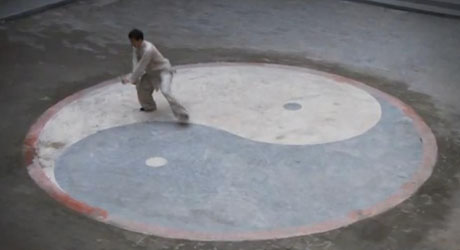
Everything is always changing.
Happy serenity is a balanced state of mind.
.jpg)
Happy serenity is a balanced state of mind, your inner peace starts with a smile. By means of tranquility the murky
becomes claer, by means of intuitive understanding the dark becomes bright. In your Tai Chi practice the still becomes
alive. Accept failure (vinegar) and succes (sugar). Don't concentrate on the definition of the Tao. Do not follow the way
of the Tao. Don't seek to arrive anywhere. Don't interfere. Don't force things, don't try to direct.
Everything is always changing.
Don't interfere.
Don't follow changes, be the change.
.jpg)
Photo : Hugolorent
Don't follow the flow, be the flow. Don't follow the Way, be the Way.
If you live spontaniously in harmony with nature, you are the flow and the Way.
The Taoist attitude is one of reverence, circumspection and... happy serenity.
And now welcome home !
Welcome to the world of essence. Welcome to the Tao.
Tao
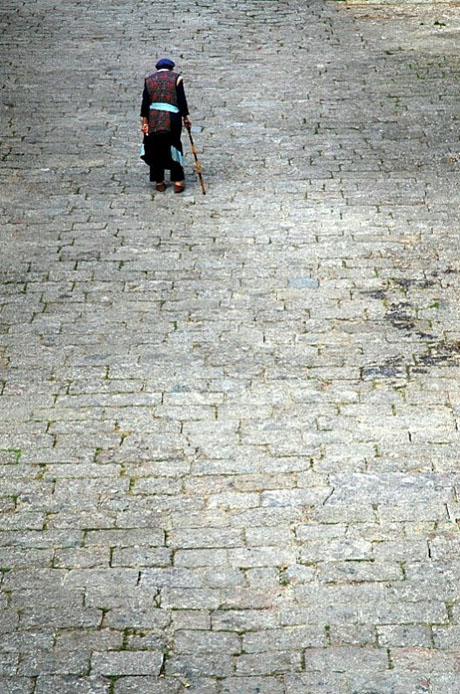
The Way.
In Heaven as on Earth.
Heaven and Earth are one.
All things are one.
Tao is the Chinese perception of the unifying soul of all things.
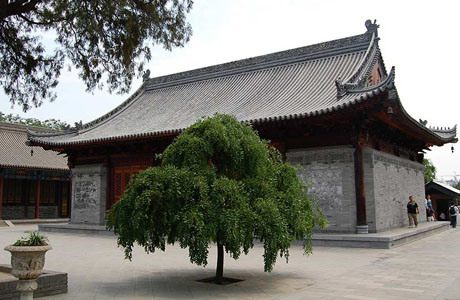
So,
"The Tao that can be told is not the eternal Tao".
"The Tao that can be told is not the eternal Tao".
Lao Tse
(Tao Te Tsing)
.jpg)
Tao is the source, it is where we come from, Tao, it is discussed in all of the three (intricate) Books: Tao Te Tsing, I Tsing,
and Tswang Tse, yet there is no single orthodox Daoist view of Tao.
The meaning of the Chinese character Tao is made of two other characters : go forward and head. In the traditional interpretation
the idea is that your head chooses the path (Tao) to go forward on to denote the path to clarity. That's the traditional
interpretation : head going, to lead the way... Chinese is a difficult language, the word Tao it's a noun who does things. For example :
humans are not nouns, we are verbs, I am a person who does things. In the same sense "Tao" may be used as a verb, Tao speaks, tells...
Tao (1) ke tao (2) fei zhang
Tao (3)
"The Tao that can be told is not the eternal Tao".
Chinese is rated as one of the most difficult languages to learn. It isn't so much words that are the problem, but individual sounds and meanings.
For example : the word Tao appears three times in the first line of the Tao Te Tsjing, yet, there is still a significant difference between the three.
Each time, the word Tao has a different meaning : the first may be translated as "the indeterminable-cosmic Tao (wu chi or emptiness, the supreme
ultimate -1). The second, as 'Tao that can be named' (told tao, philosophy, reasoning etc.. -2). The third as 'the supreme ultimate indefinable Tao'
(the supreme undeterminable and eternal Tao-3).
In other words :
What's the difference between Wu chi and Tao ?
Yet, there is still a significant difference between the two.
Wu chi (emptiness) means the supreme ultimate.
Tao is the indefinable, the supreme undeterminable.
Oops !
Oops !
Keep in mind that Tao is not limited to the Chinese border.
Chinese, Westerners, all men by nature desire to know, but the problem is that the eternal Tao is "the universal principle that underlies everything from
the creation of the galaxies to the interaction of human beings". Chinese philosophy may be seen as studies of the various aspects of Tao, but the workings
of the Tao are vast and beyond human logic and (Chinese) language.
The real problem is that there is a limit to what human beings can understand through rationality and reasoning. So, to transcend that limit one must apply intuition.
Lao Tse , Tao Te Tsing:
Chapture 1
The Tao that can be told
is not the eternal Tao
The name that can be named
is not the eternal name
Chapture 2
The unnamable is the eternally real
Naming is the origin of all particular things
. . . . . . . . . . . . . . . . .
* There are over 300 translations of this text and the number is constantly rising. Few translations of the Tao Te Tsjing
are ultimately less satisfying. "Way-making (Dao or Tao) that can be put into words is not really way-making." Etc...
* Ludwig Wittgenstein : "What can be said at all can be said clairly and what we cannot talk about we must pass over
in silence."
* Moon landing was pretty easy to do, we did it. Fully understanding each other is not an easy thing to do. I'm not here to
say: "Do it this way." But after all we can show what we can't say.
* Every character which characterizes either a concrete thing or a concrete individual is particular and not universal.
It's not OK to give words the meaning or meanings which we may think they ought to bear, and then... discuss whether the view
or views they express is true or false.
* Ludwig Wittgenstein : "Names are pure references" and: "The limits of our language are the limits of our world."
Therefore : "If a lion could talk we couldn't understand them.
Further: "The world of the happy is quite different from that of the unhappy."
Even : "If all possible scientific questions would be answered, the problems of life still have not been touched at all.
But of course then there is no question left, and just this is the answer."
Well, this is great, thanks!!
Statue of Lao Tse in Quanzhou.
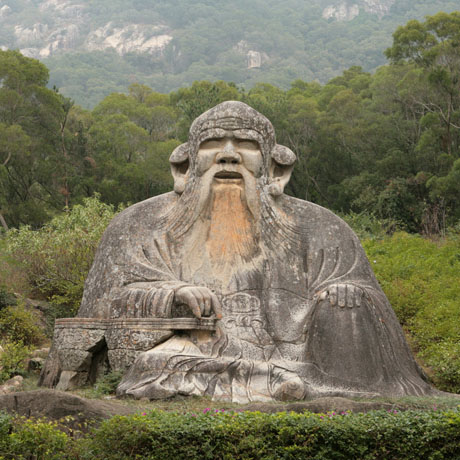
Lao Tse (Lao Zi,'the old master') was said to be a contemporary of
Confucius (551-479 before Jesus Christ)
About 25OO Years ago Lao Tse, the old master, has given to Chinese culture a no-nonsense book of 5000 words.
Often hailed as one of the wisest book ever written, Tao Te Tsjing has served as a personal road map for millions
of people. For more than 2.000 years it has inspired and guided people with its precepts of harmony. Political
and business leaders have drawn inspiration from this ancient Chinese classic.
The Tao Te Tsjing is a difficult book for people to understand, even for well-educated Chinese speakers as well.
It looks poetic, but Lao Tse, no less than Confucius, was a realist. Lao Tse's words are extremely concrete. Lao Tse:
"All difficult things have their origin in that which is easy". Keep in mind that western thought loves the abstract,
Chinese thought, with its object of practical advice, tends to be more concrete. The 'old master' was a pragmatic
truth seeker, according to him humans have no special place within the universe, being just one of the 10.000
manifestations of the Tao. "Those who talk do not know", and further: "He who talks more is sooner exhausted". Well,
Is this word game playing, is it abracadabra?
Lao Tse: "To realize that you do not understand the Way is a virtue, not to realize that you do not understand is a defect."
Understanding is acquired through practical experience and development of native intelligence.
The Tao that can be told.
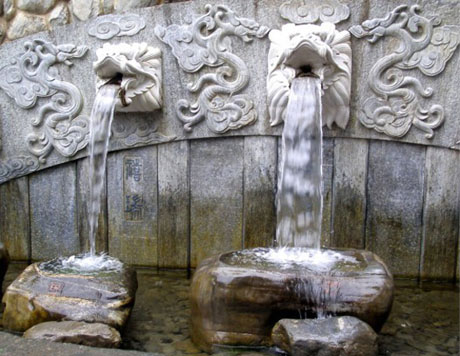
The Tao that can be told is not the eternal Tao.
Tao does not speak. Tao does not blame or condemn.
Tao has no expectations. Tao demands nothing of others.
Tao has no rules of conduct. Tao does not hate or love you.
Tao has no fatwa. Nor 72 virgins.
Tao does not promise.
Now to the point: Tao is not Jewish.
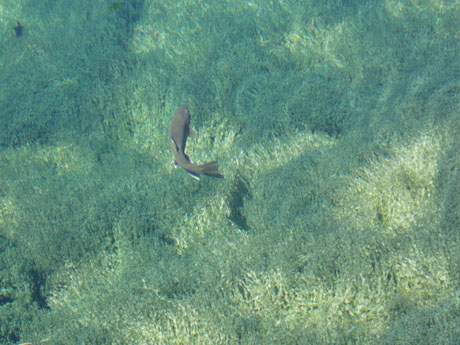
Tao is not.
The Tao is not energy, not light, not dark, not shadow, not Yin, not Yang, not duality, not unity, not complementarity,
not oneness, not, not, not. The Tao is spoke of 'via negativa', as not this or that. Not. Nature is not a "happy accident",
not a divine plan, not science, not evolution, not a theory. Nature is being, only trough practice of Wuwei (doing by doing
nothing) can one truly know the complementary aspects of being and non-being. Nature is, and nature is not. So in speaking
of the Tao the concept of complementary being-non-being has been mentioned.
Yin and Yang are only complementary aspects of nature that allows the cosmos to evolve and change with the dominance of one
aspect over the other. That way Yin and yang represent a continuum between two polar opposites as well as different and opposing
aspects within any same phenomenon. Balancing these two aspects creates harmony in nature, and this harmony is perpetuated onto
the self by the individual's practice of Wuwei.
Nature does, and nature does not. Nature does by doing nothing, so the practice of Tai Chi Chuan is an illustration of Wuwei,
where the martial artist moves along with the offensive's strikes and gives the partner nothing to strike by practicing "doing
by doing nothing". That way doing and doing nothing are complementary to each other. Balancing these two aspects creates harmony.
The taijitu is a symbol for the constant dance between the masculine and the feminine. Using the Tai Chi symbol (taijitu) we can
analyze how Yin and Yang should ideally work together, exchange, and balance each other. The circle itself is the traditional
symbol of unity (the ring) of all things.
Kindness and acceptance is the key and core to Taoism.
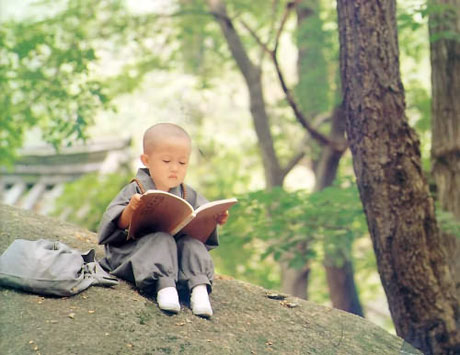
Lao Tse :
"Scholars of the highest class do not strive for anything.
Those of the lowest class are fond of striving.
Those who possess the attributes in the highest degree do not show them.
Those who possess them in a low degree hold them fast and display them.
Those who hold them firm and display them are not styled the Tao and Its attributes.
The reason why not all men obtain the True Tao is because their minds are perverted. Their minds being perverted,
their spirits become perturbed. Their minds being perturbed, they are attracted towards external things.
Being attracted towards external things, they begin to seek for them greedily. This greedy quest
leads to perplexities and annoyances; and these again result in disordered thoughts, which cause
anxiety and trouble to both body and mind. The parties then meet with foul disgraces, flow wildly
on through the phases of life and death, are liable constantly to sink in the sea of bitterness,
and for ever lose the True Tao".
"The true and abiding Tao!
They who understand it naturally obtain it.
They who come to understand the Tao abide in purity and stillness".
Lao Tse
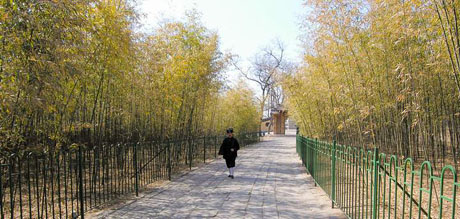
"They who come to understand the path or the way of Tao
abide in purity and stillness".
Joseph Campbell:” If you can see your path laid out in front of your step,
you know it 's not your path.
Your own path you make with every step you take.
That’s why it is your path."
Tao means: "The Way".
Science is organized knowledge.
Taoism I think must be the ancient Chinese knowledge about organisation.
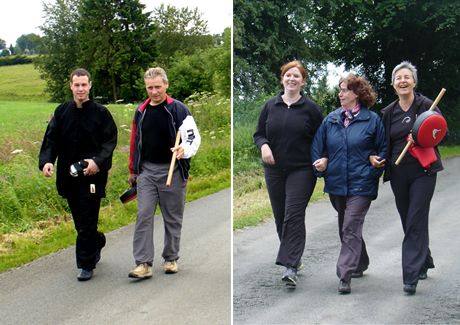
Tao: the Way
The holistic three stroke way of Tao:
1° The way all things go. (=Tao)
2° The way we have to go. (=Tao - Te Tao)
3° The way we have to go in our own way. (=Te Tao)
Tao(The Way) cannot be definite exactly.
Taoist philosophers spoke of” The Way of Tao”
in metaphysical-mystical terms as
"The Source and essence of Absolute Reality".
Taoism not only refers to the way to go,
to the way that lies behind us.
Taoism refers to what lies inside us.
But to improve the spirit of 'the Way'
we should not only be alone but not be hurried either.
Tao.
The Way or the Path.
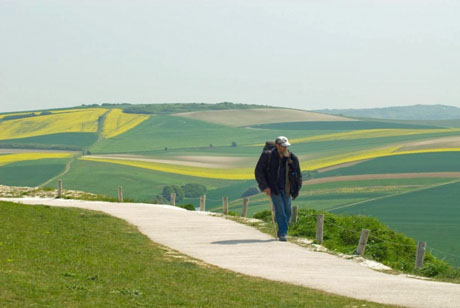
If you can see your path in front of you, it is not your path.
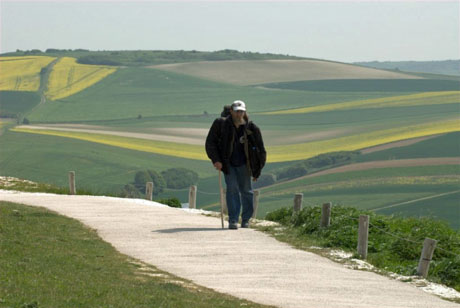
Your own path you make it with every step you take.
That’s why it is your path.
Joseph Campbell.
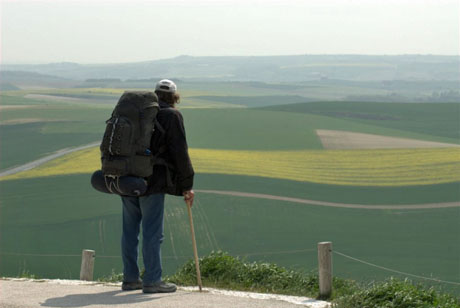
Taoism is defined by each person. There are no slots at all.
We must discern our own path and no two paths will be alike.
We seek to find out how everything will evolve.
When we seek to find how everything will evolve there is no place we could stop.
What’s without stopping can’t be described in words.
So what we end up doing is nothing simular patterns in living things.
Tswang Tse
With feet on the same side
Lao Tse appears seated on the back of a water-buffalo, patient,
kindly, as a symbol of his penetrating, fluid and benevolt wisdom.
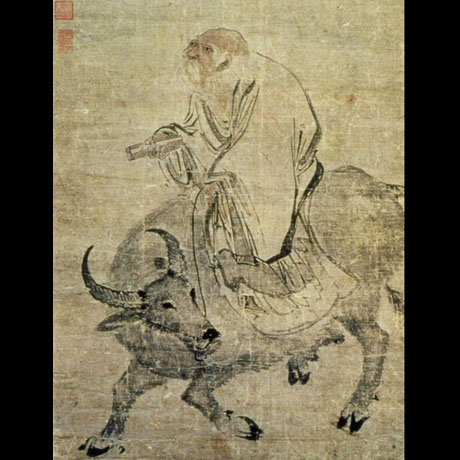
Lao Tse
The water-buffalo* is
the indomitable symbol of his humble simplicity and spiritual strength.
* The Taoist strives to be free of desire, simple and pure in tune with the natural order and the way of all things.
* The water buffalo, -associated with stomach, heart and liver merideans-, stands for longlivity, wisdom, diligence,
reliability, sincerity, strength, intelligence and no-nonsense. But don't expect this good souls to have a sparkling
sense of humor. It's not part of their package.
In Taoism there are no Cartesian dual contradictions.
Taoism is both, religion and philosophy,
in Taoism there is no contradiction between religion
(re-ligere, re-ligare) and philosophy.
There is no contradiction between practice and theory,
between action and non action.
In Taoism there is no organised doctrine,
there is no formalized cultic activity nor institutional leadership.
We should go the Way, alone and on our own way...
'Wuwei - Tzu - jan' means non action.
Doing by doing nothing on the right moment rather than the use of force
Nature is the one and only Taoistic teacher.
Tao does not speak,
Lao Tse is a spokesman of Tao.
"Life does not speak but Lao Tse is a spokesman of life. What he says is on the surface absurd; deep down there
lives a very great consistency, one has to change his own mind to penetrate it. Lao Tse believes in the unity of
opposites, and that is how life is. He doesn't add anything to it, he doesn't choose out of it, he simply accepts
whatsoever it is. To become a consumer money will help. To become a Christian love will help, to become a Buddha
meditation will help. To become a Lao Tse even meditation won't help, just understanding life as it is, and living
it with courage. Not escaping from it, not hiding from it, but facing it whatsoever it is. "To recognize Christ you
need not to be a Christ, to recognize a Buddha you need not to be a Buddha. To recognize a Lao Tse you need to be a
Lao Tse, otherwise it is impossible" (Osho on Lao Tse).
Fortunately, we are human beings, unfortunately, it is not clear how much that will help to recognize 'a Lao Tse'.
Taoism does not fall under the umbrella of a single organized religion, Tao is found in the world, especially in nature.
The problem is that if we can find Tao only as it is in the revealed nature we have no moral Tao, nature is moral
indifferent, so the Tao is moral indifferent. The problem with neutrality and moral indifference is that we need moral
standards. The problem with moral standards is that human beings are very inclined to set their own moral standards to
others, a great deal of what passes for truth consists in demonising other people's vices, faults or moral standards.
And now we have a serious moral problem : what is right and what is wrong. Arguments are made everywhere and everyday.
The Chinese concept of martial virtue.
The relationship of Taoism and Confucianism was complex, two sides of the same coin. Confucius insisted that Taoist
ideals are to be attained in everyday life through moral cultivation and the fulfillment of one's proper roles in
society. Man should strive to become the ideal man by in calculating moral virtues and kindness in themselves. Correct
perception of reality would avoid social disorder. Taoism holds no moral standards, it describes qualities and interactions,
and that's it, just relax and be natural. As for the right way, the correct way, and the only way, it does not exists.
The problem is that the martial arts world need strong values with high moral standards. Martial artists need kindness
in themselves, and treating others with kindness, what's called martial virtue.
Martial virtue applies to different aspects of life, they are a guide for one's personal development. The real warrior may
choose pacifism, others are condemned to it. The Chinese concept of 'martial virtue' is the virtue of preventing and ending
conflicts. Martial virtue means to have ten or hundreds folds without the need of applying it.
The real warrior practices both
martial skills and martial virtue simultaneously.
Philosophical foundations are what kept Chinese martial arts alive for so long. Without deep philosophical and moral foundations
Tai Chi turns into a game. Without 'martial virtue' martial arts quickly degenerate into a very dangerous form of street fighting.
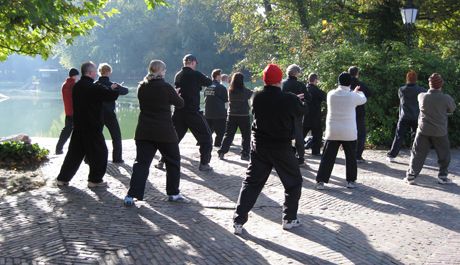
Tai Chi Chuan is the representation of some Taoistic ideals.
The core business of Tai Chi Chuan is naturalness, harmonizing the mind and the body, vitality, peace,
emptiness, detachment, the strength of softness, receptiveness, spontaneity, balance and flexibility.
As far as I think
Taoism opts out of the classical objective/subjective dialogue in favour of communal version of natural truth.
Taoism claims to dissolve so-called philosophical problems
instead of solving them
by showing that they are in fact pseudo problems
that only exist in the language game.
Taoism claims that philosophy must get past pseudo-problems
if it is to be productive.
Ludwig Wittgenstein and Lao Tse seem to have something in common.
"Wovon man nicht sprechen kan, darüber muss man schweigen".
Wittgenstein Tractatus Logico-Philosophicus
Ludwig Wittgenstein and Confusius seem to have something in common.
"What can be said, can be said clairly. The language defines the limit,
beyond that limit is nonsense".
Wittgenstein, Tractatus Logico-Philosophicus
Tao is the Chinese perception of the universal unifying soul of all things.
The universal soul always escape the net of anyone theory of the spirit.
Soul looks on with amusement and despair as theories compete acrimoniously
for the right to be the only true story.
This can take 5 minutes to discover, but a life time to grasp:
1. Taoism is a whole-system approach.
Tao always escapes the net of any single theory, it looks with amusement as theories compete for the right to be the true
story. Taoism is a whole-system approach, Heaven and Earth are two aspects of the same thing. Taoism preaches that the
Universe is a living Yin-Yang system that is creative in nature. Everything is always changing, the world of our
experience is constantly transforming. Our experience of the material world is relative to perspective and perception.
This enables us to see clearly (Ming), to act spontaneously (Tzu-Jan) and unobtrusively (Wuwei). It can take 5 minutes to
discover, but a lifetime to grasp.
2. Language.
Neither Chinese nor Western philosophy is homogeneous, the problem is that "the limits of my own language are the limits
of my own world" (Wittgenstein Tractatus Logico Philosophicus). Wittgenstein says here that the limits of our discours
are the limits of our world, The limits of our world means any way of talking and reasoning about the world, and not merely
a particular language. (For example: love has its own non-verbal language, we must learn our own love language and help
children discover their own love language.)
"Tao te tao fei zhang Tao".
Language defines the limit, beyond that limit is nonsense. Don't talk too much, just do the form, your philosophy is
'word game' playing. Philosophical disputation is a somewhat futile enterprise, here you can have plenty of fun with words,
but... But: "Right" and "Wrong" cannot be determined by logical arguments, they are relative to each other. Taoists do
not see things in terms of good or bad, right or wrong, they see things in terms of yin-yang changes, in terms of
responsability. It can take 5 minutes to discover, but a life time to grasp.
3. Yin-Yang harmony / Changes and Transformations.
Yin and Yang are two opposite but complementary forces that govern the entire universe. They reflect duality, nothing
exists without its opposite. Yin and Yang are relative to each other, all things are relative to all other things.
Practicing Tai Chi Chuan without understanding some Taoistic principles, not knowing the intent turns Tai Chi Chuan into
an exercise or a dance, better take a walk. Every part of the human body can be categorized as either Yin or Yang in
relation to the other part. Practicing the form you can distinguish not only between Yin and Yang of hand and foot, but
also between both hands and feet. It can take 5 minutes to discover, but a life time to grasp.
4. Happy serenity and peace of mind.
Relative stability and serenity can be attained when a harmony is reached between Yin and Yang which are said opposite but
related natural power fields of the universe. Taoism points that capitalism, consumentism and socialism over-emphasize
material prosperity while ignoring inner harmony, happiness and peace of mind.
"It can take 5 minutes to discover but a life time to grasp". That's what I've learned of the Tao Te Ching.
 Taoist classics: About the way.
Beyond the gate of experience flows the Way
which is ever greater and more subtle than the world.
Lao Tse -Tao Te Tsjing.
Taoist classics: About authority.
We may admit that our groping is often inspired,
but we must be aware of the belief, however deeply felt,
that our inspiration carries any authority, divine or otherwise.
Karl Popper.
Taoist classics: About the way of heaven and earth
There are more things in heaven and earth, Horatio,
than are dreamt in your philosophy;
W. Shakespeare.
One who sees the sky reflecting in the water
is able to see fish in trees.
(Chinese proverb)
Taoistic Classics: Taoistic classics: about 'the way'.
The way that can be experienced is not true.
The world that can be constructed is not true.
Beyond the gate of experience flows the Way
witch is even greater and more subtle than the world.
Lao Tse -Tao Te Tsjing.
About the known and the unknown
The known is finite, the unknown is infinite.
T.H. Huxley
About Tao
To those who have conformed themselves to the Way
the Way readily lends its power.
To those who conformed themselves to the power
the power readily lends more power.
Lao Tse
ABOUT TAOISM and THE CONCEPT OF GOD
Taoism is 'the religion of Heaven and Earth' but we can also say Taoism isn't a religion because there isn't anything
a Daoist must believe. Western religions are more antropocentric, yet none of them give human unchecked domination over
nature in satisfying their desires. Their various visions of a transcendent creator place upon humans the responsability
of being co-stewards of the environment their God has provided for their use. The active domination of nature may not
have been the intend, but some religions are more open to such interpretations in ways Taoism is not.
All of the religions show an enlightened understanding of our human duties to the environment. In Christianity the
result is love, In Taoism the result is harmony, regularity and rythm, and this spontanious action is described by Taoists
as Wuwei (non action). It is also called Tzu-jan (spontaneity). The Chinese word for Nature is Tzu-Jan and translated to
english it means "of itself so". So, in Taoism there is no transcendent creator, nature is of itself so. Nothing exists
truly in itself or of itself, but requires everything to be what is to exist.
In Taoism all things in nature, including humans are said to be 'empty of any essence or self-existence'.
All existence arises from relations of interdependence with the rest of the cosmos. All human interactions with nature
occurs within this context. Humans are seen to exist not separate from nature, but only within their interrelationship
with the whole of Nature. The ancient Chinese never developed a concept of God and they never saw nature as something that
was responding to a cosmic boss. They saw Nature as something that was self perpatuating, following a pattern of supreme
intelligence called Tao. They saw how Nature gave everything an opportunity to succeed and they understood that if they
followed the course of Nature the same realities would be experienced. Tao differs from a biblical view of God, the
greatest difference is that Tao is impersonal whereas the Christian God is personal. Tao is an energy, a force, the
Christian God is a personal being and most of us realize that the ultimate reality cannot be both, personal and impersonal.
That's OK, but that 's still a dualistic (western) way of thinking. As both a Christian and a friend of Tao I think, if
God exists, God must be both, personal and impersonal.
God must be the Supreme Ultimate Complementarity, as both full and empty (see item About talking about God). Good and evil,
yin and yang, moral relativism and moral objectivism are complementary. A key to enlightenment could be transcending this
western sort of dualistic concept of thinking, I think so. "See the children and the flowers".
Taoists, Christians, Boeddhists, they all saw that even a happy life cannot be without a measure of darkness. How do we
deal with darkness, with light?
The Taoist says: "Wisdom is the supreme part of happiness, like in nature when one door
of happiness closes another opens but often we look so long at the closed door that we do not see the one which has been
opened for us". Don 't worry about happiness, be happy. "When you are content to be simply yourself and don't compare or
compete, everyone will respect you" (Lao Tse). Most beautiful flowers and animals are content with what they are, so to
find the answers of all mysteries of life, Taoists simply looked to the most reliable thing they knew: Nature.
Nature decrees that we do not exceed the speed of light and all other impossibilities are optional. The ancient Daoist
view of reality is remarkably consistent with current scientific knowledge, Taoists believed that we live a life in
unhappiness when we don't see things as they are. Life is just a bow with which we experiment with the truth, and the
biggest challenge is being yourself in a world trying to make everyone like everyone else.
Nature is silence in motion, if the Taoist does not enjoy solitude he will not love freedom. The ideal attitude is to be
physically loose and mentally tight. Succes and failure are relative to each other, like in nature all things are relative
to all other things.
In Tai Chi Chuan succes doesn't make us and failure doesn't break us.